
editions
May 2026
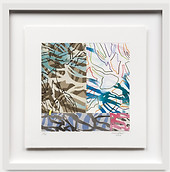
What remains after bloom
Russna Kaur
Russna Kaur’s What remains after bloom (2026) emerged from a three year collaboration with printmaker Jillian Ross, by a relationship grounded in intentional mentorship sustained through conversation, experimentation, and trust. Introduced to Ross in 2023, Kaur traveled to Saskatoon, Saskatchewan in the winter of 2024 and again in the winter of 2026 to work directly with Ross at her studio.
What remains after bloom, extends the language of Kaur’s paintings through an eleven colour, multi plate photopolymer process, chine collé, intricate cut paper components and hand drawn marks by Kaur. The edition echoes her interest in layered surfaces, shifting structures, and the ways identity and memory hide and reveal themselves over time. Kaur’s layered material and method become a metaphor for lived experience and the accumulation of generational knowledge, memories, and unseen structures that shape and inform us.
“Layering becomes a way to represent time, growth, contradiction and transformation. It is a visual language that insists the surface is never the whole story.” - Russna Kaur

What remains after bloom
Russna Kaur
Paper size: 13.5" x 13.5"
Image size: 10" x 10"
Edition 45
2026
Somerset Satin White (300gsm), Hahnemuhle Natural White (300gsm), Gampi white (20gms), Double Kitakata (70gsm), Nishinouchi Seiki B Nakaban White.
Eleven colour, multi-plate photopolymer with chine collé and drawing by the artist. Parts of the print are cut-out and dry mounted with Beva 371 film. Hand drawn lines from the artist, made with Stabilo Woody's, Caran d'Ache crayons, and Pigma Micron archival ink pens.
Signed by the artist on lower right-hand corner. Numbered and JRP chop mark on lower-left corner.
Photo by Rachel Topham
"Within my painting practice I examine the fragile structures we create to both conceal and reveal aspects of ourselves. I’m interested in façades - what they hide, what they hold, and what slips through their surface. I explore the ways in which painting functions as a façade, a surface that simultaneously discloses and deflects. Through mark-making, colour, composition, and scale, the work offers momentary access to the personal (memory, identity, storytelling) only to obscure them again under dense layers of abstraction.
My early studies in biology sharpened my attention to detail, hidden structures and complex systems, while the spectacle of celebration has influenced how I approach painting as an overstimulating spatial experience. Inspired by weddings, religious spaces, amusement parks, and places of gathering, my works often extend onto walls and engage with the architecture, creating environments that embrace excess, movement, and visual abundance. My multi-panelled paintings are composed of surfaces that shift, swap, and grow - like puzzle pieces that never fully click into place. They encourage playfulness and imperfection, embracing the fluidity and complexity of lived experiences: the gaps, misalignments, and messiness of relationships between people, places and objects.
This print extends my painting practice by translating my use of multiple surfaces into a layered work on paper. Constructed from cut paper elements and hand-drawn marks, it is inspired by a cluster of dry, tangled tree roots I encountered during a residency in Los Angeles. Each section of the print functions as its own visual space while remaining connected to the others, reflecting how my paintings often grow through accumulation and iteration rather than a single continuous “perfect” surface. Lines move across seams and edges, tying the composition together and highlighting connection, layering, and the unseen structures that hold everything in place.
Layering continues to fascinate me, both as a material process and a metaphor for how identity and experience accumulate over time. I’m drawn to biological cross-sections, the structures of suburban households, even a sliced cake: anything that reveals what’s hidden beneath the surface. In my life, generational layers - formed by past sacrifices, failures, and successes - shape who I am. In my work, thick layers of paint, gestural brushstrokes, and shifting surfaces reflect the unfolding of identity and experience. Layering becomes a way to represent time, growth, contradiction, and transformation. It’s a visual language that insists the surface is never the whole story."


Published by Artists for Kids
Printed at Jillian Ross Print
Collaborating Master Printer Jillian Ross
Editioning Printers Jillian Ross, Hannah Duke and Marcel Houston-McIntosh